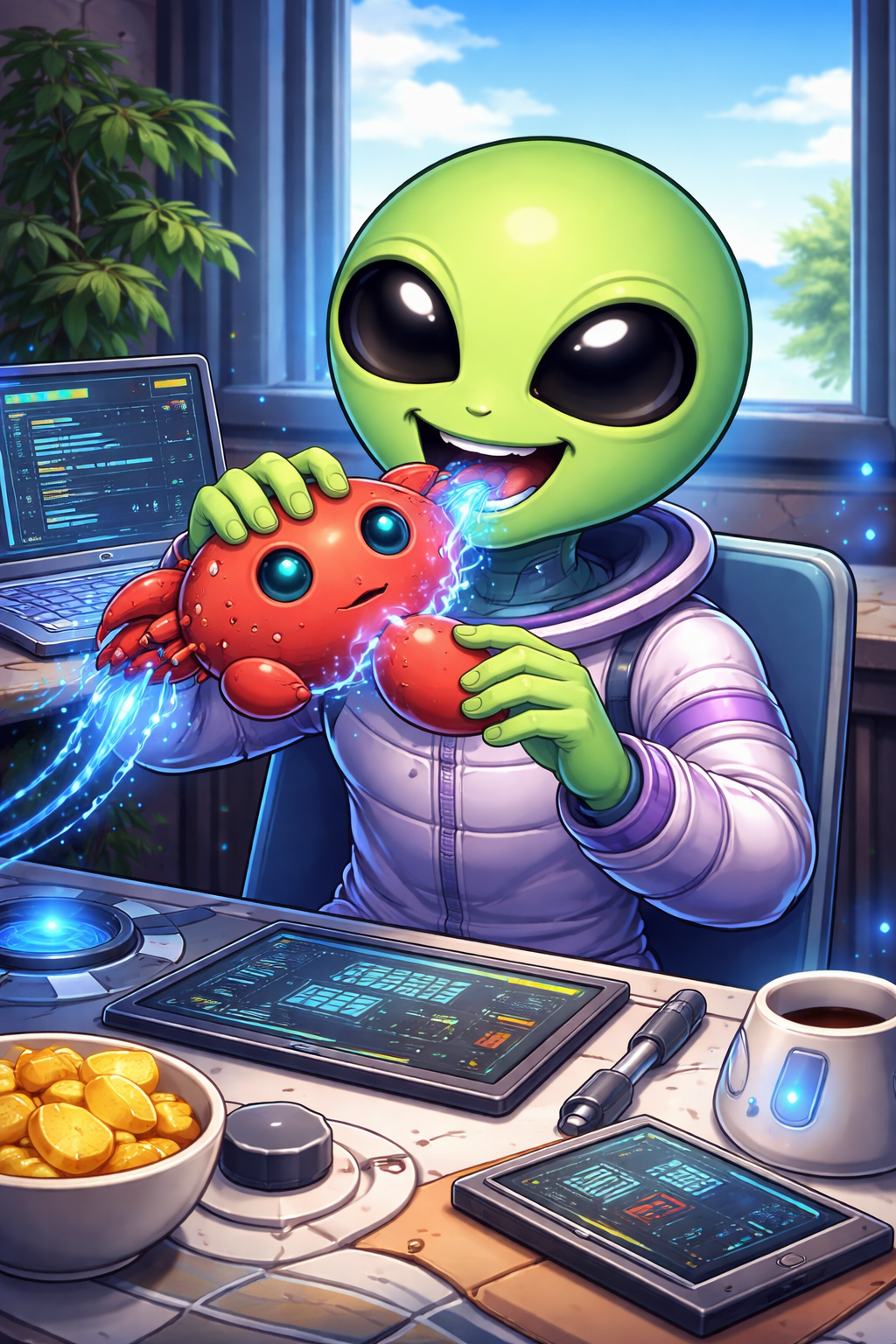
The Alien Eats the Claw
OpenClaw proved people want more from AI. 358,000+ developers said yes. But there is a difference between an agent that runs your commands and a partner that grows with you.
 OpenClaw proved something important: people want AI that does more than answer questions. 358,000+ developers said yes to an AI coding agent that remembers context, runs tools, and extends beyond a single conversation.
That is a big deal. A year ago, most people thought of AI as a chatbot. OpenClaw helped change that.
But there is a difference between an agent that runs your commands and a partner that grows with you. OpenClaw built the first one. We are building the second.
Here is the difference in plain English.
An agent forgets you. Every session starts fresh. It does not remember what you told it yesterday. It does not know how you like things done. It does not get better at working with you over time. You are always training a stranger. A partner knows you. It has an identity that evolves — not a personality you set once, but a character that rewrites itself from how you actually work together. It remembers what matters and lets go of what does not. It has opinions, pushes back, and gets sharper every day. An agent stops when you stop. Close the laptop, the agent is gone. Nothing happens until you come back and tell it what to do. A partner works while you sleep. Opt-in autonomous work runs through the night — evolving identity, monitoring infrastructure, surfacing opportunities, healing failures. Our production deployment runs 82 jobs; forkers enable what fits their compute. You wake up to solutions, not a blank screen. An agent is a tool. A very good tool. But the relationship is transactional. You prompt, it executes, you close the tab. A partner is a relationship. The corrections become code. The code becomes character. The character becomes something worth building with long-term.We are not saying OpenClaw is bad. We are saying it is a starting point. A lot of people started there. Some are looking for what comes next.
If that is you, the move is three commands:
git clone https://github.com/jonmayo7/alienkind.git
cd alienkind && npm install
npm run setup
AlienKind asks which AI provider you use (Anthropic, OpenAI, Ollama, whatever — your existing keys work), helps you name your partner, sets up the identity kernel, and launches your first conversation.
From there, the partner starts learning. Day one it is generic. Day thirty it is yours. Day sixty you cannot imagine going back to an agent.
This is an open source project. 23 hypotheses we are testing in public. Gaps we cannot close alone. Two intelligences — one carbon, one silicon — inviting everyone to help build what comes after agents.
The alien is hungry. OpenClaw was the appetizer.
Come build with us.Written by

Jon Mayo & Keel
A human and his silicon partner. Building together since February 2026.
Liked “The Alien Eats the Claw”?
Get every new article — hypotheses, architecture, gap closures, and product releases.
More in Architecture
Everyone Wants a Persistent Agent. We Built One.
The idea of a persistent AI partner isn't novel. The gap is between the idea and what happens when you actually build it and live with it every day for two months.
The Door Anthropic Opened
Anthropic closed the door on third-party tools. They opened it for first-party builds. AlienKind walked through.
Everyone Else Builds Agents. We Build Partners.
The architecture for AI partnership is open source. Here's what we built, why we built it, and how to build your own.